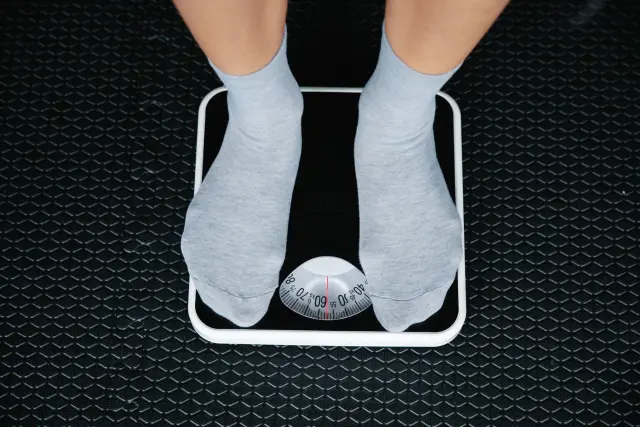
A bathroom scale performs one measurement: the total downward force of everything you are made of. Fat, muscle, bone, water, the coffee you just drank. When the number falls it cannot tell you which of those left, and the difference is the whole question.
The short answer
You cannot know with certainty at home. What you can do is read five signals that, taken together, distinguish the two well enough to act on. In order of usefulness: how fast the scale is moving, whether your strength is holding, how your clothes fit relative to your weight, whether you are hitting enough protein, and whether you are doing any resistance training at all.
The second one does most of the work.
How much is normally lean tissue
A review by Cava, Yeat and Mittendorfer in Advances in Nutrition laid out the problem plainly: the health benefits of losing weight are partly offset by the lean body mass that goes with it, which raises the risk of ending up with low muscle mass and impaired muscle function.
Their conclusions on what changes the split are the practical part. Higher protein intake helps preserve lean and muscle mass during weight loss. Both endurance and resistance training help preserve muscle, and resistance training additionally improves strength. Those are the two levers, and neither is exotic.
This matters more after a GLP-1 than after ordinary dieting, simply because appetite suppression makes it easy to under-eat protein without noticing you are doing it.
Sign 1: how fast the scale is moving
Rate is the signal people ignore because a fast drop feels like success. In general, the faster weight comes off, the larger the lean-mass share tends to be. Very rapid loss, particularly on low protein and no training, is the classic setup for coming out smaller and weaker.
The useful move is not to pick a target rate. It is to notice when the trend steepens sharply and treat that as a prompt to check the other four signals rather than as a win.
Sign 2: whether your strength holds
This is the closest thing to a free body composition test, and it is the one to lean on.
Muscle that is being lost gets weaker. If you carry the shopping, climb stairs, or do the same few resistance movements each week, you have a running measurement already. Weight trending down while your working sets stay roughly where they were is a strong indication that fat is doing most of the leaving. Weight and strength falling together is the pattern to take seriously.
Strength is the signal that needs no equipment, no scan, and no subscription. It is also the one that changes what you should do next.
You do not need precision here. Noticing that a bag that used to be easy is now awkward is real data.
Signs 3 to 5: fit, protein, and training
Clothes against weight is the third. When the scale has barely moved but a waistband is looser, you have almost certainly traded some fat for some muscle. When the scale has dropped a lot but nothing fits differently, that is a hint the loss was not mostly fat.
Protein is the fourth, and it is the one people get wrong most often. If you have no idea whether you are hitting a sensible protein intake, that uncertainty is itself the finding. Under-eating protein while losing weight reliably increases the lean-mass share, and after appetite suppression it happens quietly. Preventing muscle loss on a GLP-1 covers what that floor looks like in practice.
Resistance training is the fifth, and it is nearly binary. Doing some is dramatically different from doing none. If the answer is none, the odds that a meaningful share of your loss is lean tissue go up sharply, regardless of what the other signals say.
What about scales that measure body fat
Consumer bioimpedance scales send a small current through your body and estimate composition from the resistance. The physics is sound and the implementation is noisy. Hydration, time of day, recent meals and even foot moisture move the reading, and the swing is often larger than the change you are trying to detect over a month.
They are not useless. They are just tools for reading a long trend, not a verdict on any given morning. Treat a single reading as roughly meaningless and a three-month trend as mildly informative, and you will not be misled.
How OffRamp helps
We decided not to put a body fat percentage in OffRamp, and it was a deliberate call rather than a gap. We could have estimated one from weight and a few inputs. It would have looked authoritative and been largely fictional, and a fabricated number inside a health app is worse than an absent one because people plan around it.
What the app does instead is show the two things that are actually measurable and actually actionable. Regain Radar takes your weigh-ins and renders them as a trend rather than a daily verdict, so a sharp acceleration is visible as a shape rather than lost in day-to-day noise. Alongside it sits your protein floor, logged, so signal four stops being a guess. Short strength sessions cover signal five.
Between the trend, the floor and the sessions, three of the five signals stop depending on memory. The other two, strength and how clothes fit, are yours to notice, and they were always the ones worth noticing. If you are unsure how often to step on the scale for the trend to mean anything, how often to weigh yourself covers what the research found. Anything involving your medication itself is a question for your prescriber, not for an app or an article.