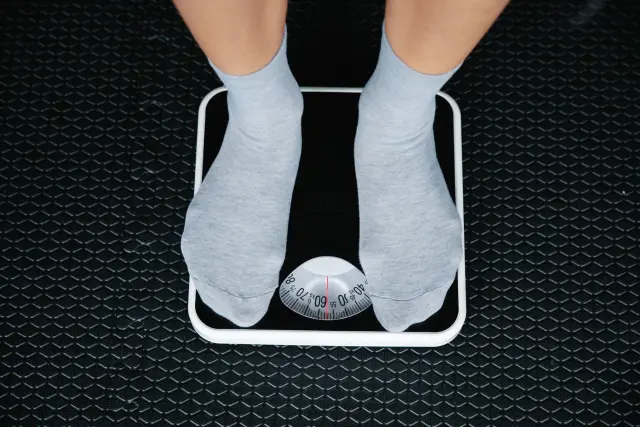
Water weight gets used as a shrug. Someone gains three pounds over a weekend, says it is water, and moves on. The shrug happens to be correct, and it is worth knowing why, because the mechanism is specific and measurable rather than vague.
The short answer
Water weight is body water moving in and out of storage, not tissue you built or lost. In a 1970 study published in Acta Physiologica Scandinavica, 19 men were depleted of muscle glycogen with hard arm and leg exercise, held on a protein and fat diet for three days, then switched to a carbohydrate-rich diet for four. Their total body water rose by 2.2 litres over that carbohydrate period. That is 4.9 pounds on a scale, and their fat mass had nothing to do with it.
Four days. Nearly five pounds. Entirely reversible.
The 3-to-1 rule behind most of it
Your body stores carbohydrate as glycogen in muscle and liver, and glycogen does not store dry. The researchers in that 1970 experiment calculated that at least 500 grams of glycogen had been laid down, which works out to roughly 3 to 4 grams of water bound with every gram of glycogen. That ratio has held up in later work and it is the single most useful number in this whole topic.
Run the arithmetic and the mystery disappears. A typical adult can hold somewhere in the region of 400 to 600 grams of glycogen when topped up. Multiply by three or four and you are looking at well over a kilogram of water that exists purely because the fuel is there. Empty that store and the water goes with it.
Glycogen is not a dry powder in a jar. It is a wet store, and the water it carries is real weight that a scale cannot distinguish from anything else.
A 2023 narrative review in Nutrients revisited this relationship and found the picture is a little messier than a fixed ratio, with the exact figure varying by measurement method and by how depleted the muscle was to begin with. The direction is not in doubt. Only the decimal places are.
Sodium moves water within hours
The second driver runs faster than glycogen does. Sodium holds water in the fluid outside your cells, so a meal well above your usual sodium intake pulls water into that compartment and holds it there until your kidneys catch up. That is typically one to three days, and it explains why a restaurant dinner shows up on Sunday morning and is gone by Tuesday.
What it is not is a storage decision your body made about fat. Nothing about that meal was converted into tissue overnight, because tissue does not form that fast. The scale is reporting a change in fluid distribution, correctly, and then reporting the reversal a day or two later, also correctly.
Why a low-carb week starts with a drop
The fast first week of any low-carbohydrate diet is the 1970 experiment run backwards. Cut carbohydrate, burn through the glycogen, and the 3 to 4 grams of water per gram leaves with it. Several pounds can go in five or six days, which feels like extraordinary progress and is mostly a change in a fuel tank.
Then the drop stops, because the tank is empty and there is no more bound water to release. The second week looks like a stall, and it is not: it is the first week that was unrepresentative. Reintroduce carbohydrate later and the same water comes back, which is why so many people describe gaining several pounds overnight after one normal meal. They did.
This is also the mechanism behind a lot of what people file under rebound weight gain. Some of it is genuine regain. The first few pounds usually are not.
Heat, hormones, and a hard session
Three smaller inputs account for most of the rest. Heat and long flights both promote fluid retention, which is why a hot week or a travel day reads high. The menstrual cycle shifts body water on a predictable schedule for a lot of people, with the luteal phase running heavier. And an unfamiliar strength session pulls fluid into the muscle as part of the repair process, so a first session back can add a pound or two that has nothing to do with anything you ate.
Each of these resolves on its own timescale. None of them needs a fix.
Salt and carbohydrate also interact, which is why a single restaurant meal can produce a larger jump than either input would alone. A big plate of pasta arrives with both the carbohydrate that refills glycogen and the sodium that holds fluid outside the cells, and the two effects stack on the same morning. The reversal stacks too, which is why the number often drops further than expected two days later.
How OffRamp handles it
This is the reason OffRamp shows a trend line rather than a daily number, and it came out of watching early testers. People were reacting to Tuesday. A reading two pounds up on a Tuesday morning would trigger a whole day of compensating behaviour, and by Thursday the number had returned on its own without anyone doing anything.
So Regain Radar, the feature that watches for real upward drift, is deliberately built not to fire on single readings. It looks at the direction of the trend across weeks, because that is the only signal that outlasts a salty dinner and a full glycogen store. A tool that flagged every water swing would be technically accurate and practically useless.
The protein floor works the same way. It is a daily target you either hit or do not, and it is unaffected by what the scale did that morning, which is the point. If you want the companion question, we wrote a separate piece on how much your weight actually moves in a day and another on how often to step on the scale at all.