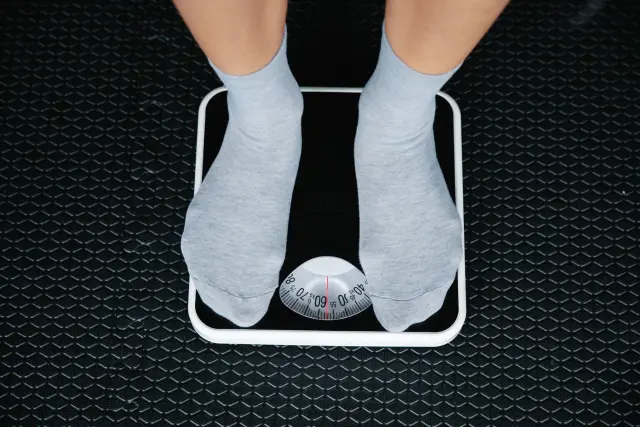
Two pounds appear on a Monday. The honest question is not whether that is bad, it is whether it is anything at all. There are four checks that answer it, and they get more reliable as you work down the list.
The short answer
Water arrives overnight and fat does not, so speed is the first and strongest test. Body fat is tissue, and tissue is built and lost slowly, in fractions of a pound over days. Body water moves in litres within hours. If a number appeared between Sunday night and Monday morning, it is fluid, and no further analysis is needed until a week has passed.
Test one: how fast it appeared
This one is close to absolute. Gaining a genuine pound of fat tissue is a slow process that no single evening can accomplish, which means an overnight jump has to be something else. Fluid, food still in transit, and glycogen with its bound water are the candidates, and all three move at exactly the speed the scale reported.
The reverse holds too. A three-pound drop after two days of eating less is not three pounds of fat, and treating it as proof that something is working sets up disappointment in week two, when the drop stops because the glycogen has already gone. We covered that mechanism in detail in what water weight actually is.
Test two: how big the number is
Size is the second filter, and there is real measurement behind it. In a series analysing more than 9,500 days of standardised body mass readings in a healthy adult, published in Renal Failure in 2023, the average relative difference across a one-day interval had a standard deviation of 0.53 percent, rising to 0.69 percent across a seven-day interval.
Put a body on that. At 180 pounds, 0.53 percent is about a pound. So a one-pound morning difference is not a small change, it is the expected amount of nothing. Two to three pounds is still inside the range that ordinary fluid and food volume produce. It takes a persistent shift of several pounds, held across weeks, before the number is describing tissue.
A single reading has an error bar, and the error bar is about a pound. Most of what people react to sits inside it.
Test three: the 48 hours before it
Now look backwards rather than forwards. Five things reliably produce a fluid jump, and one of them is almost always present when the scale surprises someone: a meal far saltier than usual, a much larger carbohydrate intake than usual, a long flight or a hot day, an unfamiliar or unusually hard training session, and for many people the luteal phase of the menstrual cycle.
If any of those sits in the preceding 48 hours, you have your explanation and you can stop. If none of them does, the reading is more interesting, and it moves to the last test rather than becoming a conclusion on its own.
Two of those five are worth flagging because people rarely count them. A first strength session after a break pulls fluid into the working muscle as part of ordinary repair, so a return to training can add a pound or two that looks exactly like a setback and is in fact the opposite. And a long flight produces measurable lower-limb fluid pooling that can take a full day to clear after landing.
Test four: what seven days do to it
The definitive test is time, and seven days is the shortest interval that is worth anything. Water retention from food, travel, or training has cleared inside three days at normal fluid intake. So a reading that is still elevated at day seven, against a trend line rather than against one prior morning, is describing something other than fluid.
Two rules make this work in practice. Compare a week's average to the previous week's average rather than comparing two individual days, because averaging is what removes the 0.53 percent noise. And do not restart the clock every time a reading moves the wrong way, which is the most common way people never get a seven-day answer at all.
Our piece on how often to weigh yourself covers the frequency side of this, and how much weight moves in a day covers the raw size of the swings.
What these tests cannot tell you
They separate fluid from tissue. They do not tell you what kind of tissue. A slow, real upward trend could be fat, and it could also be muscle if you have recently started training seriously, and a scale cannot distinguish those. That is a different question and it needs different evidence, which is what the muscle or fat question is about.
They also cannot make a single morning reading meaningful. No test can. That is the nature of the measurement, not a flaw in the method.
And they say nothing about why a real upward trend is happening, only that it is real. Returning appetite after coming off a GLP-1, a change in training, a new medication, or a genuinely different pattern of eating all produce the same shape on a chart. Establishing that a change is real is the first step, not the answer.
How OffRamp runs this for you
All four tests are really one instruction: judge the direction, not the day. That is why Regain Radar in OffRamp watches the trend across weeks and stays quiet through single readings, however dramatic they look. It was a deliberate build decision, and it came from testers who were reacting to noise and then reacting to their own reaction.
The protein floor runs on the same logic. It is a daily behaviour you either hit or do not, independent of what the scale said that morning, so a water swing cannot knock the one thing that actually protects lean mass off course.