There is a test that takes about ten seconds, costs nothing after the equipment is bought, requires no blood, and predicts death from any cause better than blood pressure does. It is squeezing a handle.
This is real, it is replicated, and almost every popular article about it draws the wrong conclusion from it.
The short answer
Grip strength is a very good proxy for total body strength, and total body strength tracks health outcomes closely. The PURE study, published in The Lancet in 2015, measured grip strength with a Jamar dynamometer in 139,691 adults across 17 countries of widely different incomes, then followed them for a median of 4 years. Each 5 kg reduction in grip strength was associated with a 16 percent higher hazard of all-cause mortality, a 17 percent higher hazard of cardiovascular death, and smaller but real increases for heart attack and stroke.
What it is not is a hand fitness test. Nothing in that finding suggests your fingers are doing the work. Grip is simply the easiest thing to measure reliably in a hundred thousand people across seventeen countries.
What the PURE study measured
The design is what makes it convincing. PURE enrolled households rather than volunteers from clinics, spanning high, middle and low income countries, and used the same instrument everywhere. Of the participants with known vital status, 3,379 died during follow-up.
The association held across country-income strata for almost every outcome, which rules out a lot of the confounding you would normally worry about. It also found the boundaries of the effect, which matters just as much: there was no significant association between grip strength and incident diabetes, hospital admission for pneumonia or chronic obstructive pulmonary disease, injury from falls, or fracture. A finding that predicts some things and not others is behaving like a real signal rather than a statistical artefact.
Stronger than blood pressure, with a caveat
The line that gets quoted most is that grip strength was a stronger predictor of all-cause and cardiovascular mortality than systolic blood pressure. That is accurate and it is genuinely surprising, given how much clinical attention one gets and how little the other does.
The caveat is the part that never survives the headline. Prediction is not causation. Grip strength is downstream of muscle mass, nutrition, activity, illness and age all at once, which is exactly why it predicts well. The PURE authors wrote plainly that further research is needed to test whether improving strength actually reduces mortality, and that question is still open more than a decade later.
So the correct reading is that low grip strength is informative, not that a dynamometer reading is a lever you pull.
Half a million more people found the same
A 2018 analysis in The BMJ ran the same question through UK Biobank, 502,293 participants aged 40 to 69, followed for a mean of 7.1 years, with 13,322 deaths. Per 5 kg lower grip strength, the hazard ratio for all-cause mortality was 1.20 in women and 1.16 in men, with similar increases for cardiovascular, respiratory and most cancer outcomes.
It also asked something PURE did not: whether grip strength adds anything to a standard office-based risk score built from age, sex, diabetes, body mass index, systolic blood pressure and smoking. It did, though the improvement in predictive ability was small. Two very different cohorts, on two continents, pointing the same direction.
Why it matters after rapid weight loss
This is where it stops being trivia. Weight lost quickly is not all fat, and lean mass that goes during a loss phase does not come back on its own. If strength is the thing these cohorts are really tracking, then losing lean mass is not a cosmetic issue about how you look in a mirror. It is a change in the variable that predicts outcomes.
That is the same argument behind preventing sarcopenia, arriving from a different direction. It is also why the practical signals for whether you are losing muscle or fat are worth knowing during a loss phase rather than after it. If you notice real, ongoing weakness rather than ordinary tiredness, that belongs in a conversation with your prescriber.
Why grip, of all things
The choice is practical rather than physiological. A dynamometer is portable, costs little, needs no calibration by a specialist, works in a village clinic and a research hospital alike, and produces a number in seconds that does not depend on the participant understanding an instruction beyond squeeze hard. Very few other measures of physical capacity survive being deployed across seventeen countries by different teams.
It also happens to correlate reasonably well with strength elsewhere in the body, because the things that build forearm and hand strength are the same things that build everything else: total muscle mass, habitual physical work, adequate nutrition, and the absence of underlying illness. Grip is a window onto that bundle. It is not the bundle.
Which is why the finding survives so many adjustments. When a measure is picking up general physical robustness rather than one organ system, it keeps predicting after you control for the individual organ systems.
What actually changes it
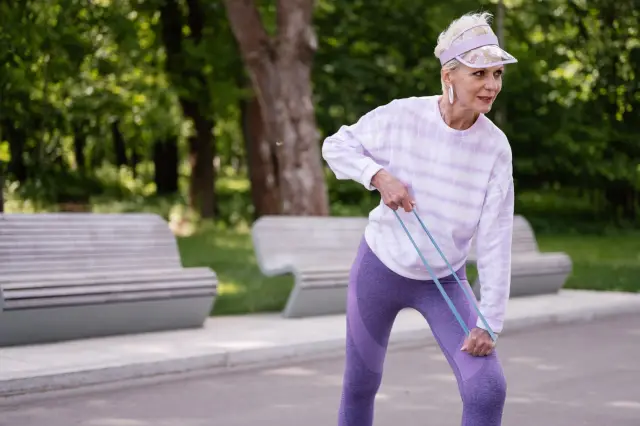
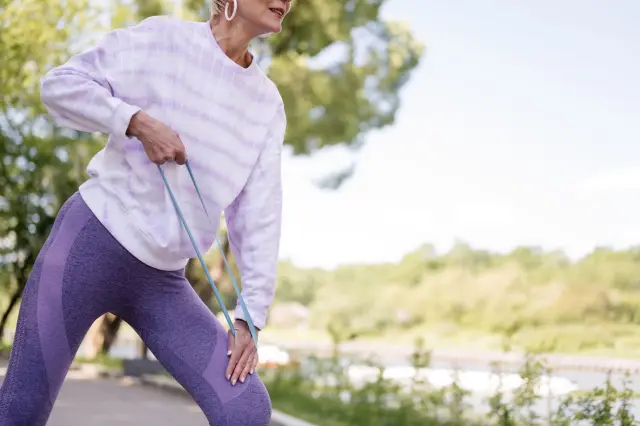
Whole-body resistance training and enough protein to build from. Not grip trainers, not stress balls, not hanging from a bar, all of which will improve your grip specifically and leave the thing it stands in for untouched.
This is the same distinction as reading a thermometer versus opening a window. Grip strength is the reading. Muscle mass and strength are the room. A gripper raises the reading without touching the room, which is the one intervention guaranteed to break the association these studies found.
There is a second-order benefit worth mentioning, though. Compound movements that involve holding something, rows, carries, Romanian deadlifts, train grip incidentally while training the thing that matters. OffRamp's dumbbell plan includes bent-over rows and Romanian deadlifts for reasons that have nothing to do with grip, and improves it anyway. That is the right order: train the room, and the reading follows.
How OffRamp handles this
OffRamp does not measure grip strength, because a phone cannot and any app claiming otherwise is guessing. What it does is act on the two inputs that determine the underlying thing.
The protein floor is 1.6 g per kg of your goal weight, rounded to the nearest 5 g, raised by 10 percent on a reset plan. The strength side is three plans, bodyweight, dumbbells or bands, at two 20-minute sessions a week, with the sets and reps already written down. And the weight side runs on a seven-day trend, flagging only when the average holds at or above baseline times 1.02 for a full week, so that a normal fluctuation never gets treated as regain. Strength is the thing worth protecting. The scale is just the noisiest way to look at it.