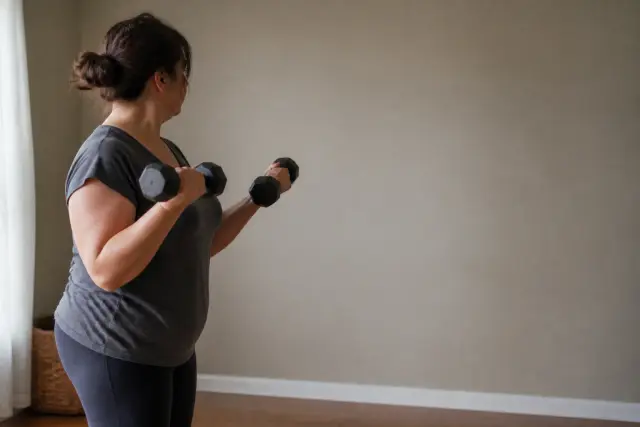
Progressive overload is one of the few genuinely load-bearing ideas in strength training, and it is usually explained in a way that makes it sound like it requires a gym membership.
It does not. What it requires is that the work gets harder over time in some measurable way.
The short answer
Progressive overload means gradually increasing the demand on a muscle so it keeps having a reason to adapt. Muscle responds to a stimulus it is not already accustomed to, so repeating the identical session forever eventually produces nothing. Adding weight is the most obvious way to increase demand. It is not the only way, and an 8-week randomised trial published in PeerJ in 2022 tested the main alternative directly and found it worked about as well.
The definition without the jargon
Take a set of ten squats. That set is a certain amount of work. If in three weeks you do the same ten squats and they feel the same, your body has no reason to change anything, because it has already adapted to exactly that.
Overload is the gap between what you can comfortably do and what you are asking for. Progressive overload is keeping that gap open as your capacity rises. Everything else in this article is bookkeeping about which variable you use to keep it open.
The 8-week load versus reps trial
The 2022 trial recruited 43 people with at least a year of consistent lower-body training and split them into two groups. Both did four sets of four lower-body exercises, back squat, leg extension, straight-leg calf raise and seated calf raise, twice a week for 8 weeks. One group increased the load while holding the repetition range constant. The other increased repetitions while holding load constant.
The results were close to a draw. Rectus femoris growth modestly favoured the repetitions group, by 2.8 mm summed across measurement sites. Dynamic strength slightly favoured the load group, by 2.0 kg on the squat. The authors described both differences as being of questionable practical significance, and found no other notable differences between the groups.
That is a more useful finding for a home trainee than almost anything else in this literature. If your equipment tops out at one pair of dumbbells, you have not lost the mechanism. You have lost one of several ways to apply it.
Four ways to progress with no heavier weight
Repetitions is the first and the one with a trial behind it. Ten becomes twelve, twelve becomes fifteen, then you find a harder version of the movement and start again lower.
Range of motion is the most underrated. An incline push-up with your hands on a kitchen counter and the same push-up with your hands on a low chair are different exercises, and moving between them is a substantial jump in load that costs nothing.
Tempo works because time under tension is part of the stimulus. Lowering over three seconds instead of dropping makes an identical set of ten meaningfully harder.
Rest is the last one and the easiest to abuse. Cutting rest between sets raises the difficulty, but it does so by making you more fatigued rather than more capable, so it is better used to fit a session into less time than as a primary progression.
Knowing when to add something
The signal is simpler than any app can make it. If the final repetition of a set is difficult but your form is unchanged, the load is about right. If the final repetition looks the same as the first, the set has stopped asking anything of you and something needs to go up.
The common error is progressing on a schedule rather than on that signal. Adding a rep every session because the calendar said so works for about three weeks and then produces sets you cannot complete properly, which is not overload, it is just failure with extra steps. Adding nothing for two months because the sheet says 3 sets of 12 is the opposite error and is far more common in people training at home.
One variable at a time is enough. If you added two reps, do not also slow the tempo and cut the rest in the same week, because when the session stops working you will not know which change did it.
Why the curve flattens faster than you expect
A 2003 meta-analysis in Medicine and Science in Sports and Exercise mapped the dose response for strength development and found what everyone who has trained for a while already suspects: untrained people improve on almost anything, and trained people need more work for less return.
The practical read is that the first few months are unusually generous and then the rate slows for everyone. If you are eighteen months into maintenance and progressing slowly, that is the curve behaving normally, not a programme failure. It also means the correct response to a plateau is usually patience and consistency rather than a dramatic overhaul.
Why OffRamp's plans hold sets and reps fixed
This is worth being direct about, because it looks like a contradiction. OffRamp ships three strength plans, bodyweight, dumbbell and bands, each with two 20-minute sessions a week, and the sets and reps are written down and do not change. Bodyweight squat, 3 sets of 12. Incline push-up, 3 of 10. Glute bridge, 3 of 15.
That was a deliberate decision and the reasoning is about adherence rather than physiology. The people this app is built for are in maintenance after a large weight loss, often years past their last structured programme, and the failure mode that ends their training is not insufficient overload. It is the session not happening. A fixed prescription removes every decision except whether you did it.
So the plans set a floor, in the same way the protein number does. Progression is yours to apply on top, and the trial above says the reps route is available to you even if the dumbbells never get heavier. If you want the frequency question rather than the progression one, two sessions a week is the bar and more has diminishing returns.
How OffRamp helps
Three plans, two 20-minute sessions a week, every exercise written out with a cue and the most common mistake attached to it. Sessions are ticked off against a weekly target, so the thing being tracked is whether the work happened.
Alongside that sits the protein floor at 1.6 g per kg of goal weight, because progressive overload with nothing to build from is just fatigue. Training supplies the signal. Protein supplies the material. Neither one substitutes for the other, and both are simpler than the internet makes them sound.