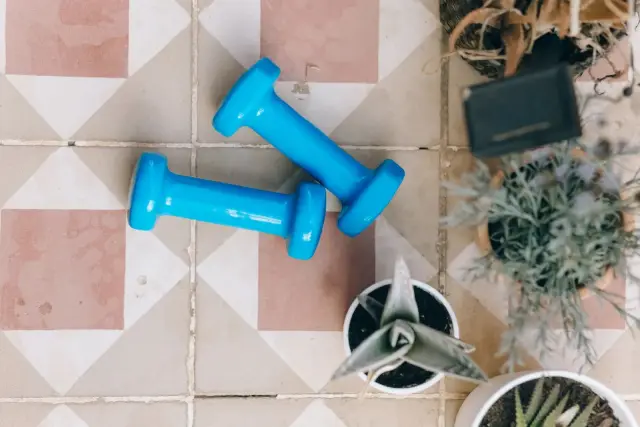
Two to four short strength sessions a week is the range that actually protects your results during weight loss, and going well beyond that adds diminishing returns rather than faster progress. The signal that tells your body to hold onto muscle instead of burning through it doesn't require daily training, it requires consistency and a little added challenge over time.
How often is enough
Two sessions a week is the floor that shows measurable benefit in most research on resistance training and body composition. Three to four sessions a week is where most people land who want a bit more, hitting each major muscle group at least twice weekly. Beyond four or five sessions, the returns flatten out fast, and the bigger risk becomes burnout or injury from poor recovery rather than undertraining.
Why strength training matters here
Weight loss, whatever is driving it, doesn't come exclusively from fat. Some portion typically comes from lean mass too, and resistance training is the strongest signal available for telling your body to protect muscle preferentially instead. That matters because muscle is metabolically active tissue: holding onto more of it means your body burns more at rest, which makes the results you've worked for easier to maintain once you're done losing. This is the same mechanism behind preventing muscle loss on a GLP-1, just applied to weight loss broadly rather than one specific method.
This matters more as people get older, too. Muscle mass naturally declines with age at a rate that accelerates without resistance training to counteract it, so someone in their forties or fifties losing weight without any strength work is losing lean mass on two fronts at once, from the calorie deficit and from age-related decline. Strength training is the one lever that pushes back against both simultaneously, which is part of why it earns a place in almost every serious weight-management plan regardless of the specific method someone is using to lose the weight.
What a session actually needs to include
A session doesn't need to be long to count. Twenty to thirty minutes covering the major movement patterns, a squat or lunge, a hinge like a deadlift or hip bridge, a push like a press, and a pull like a row, covers most of what matters. The other non-negotiable is progression: gradually making the work a little harder over weeks, whether that's more reps, more weight, or a harder variation. Without progression, the same workout stops sending a strong enough signal after the first month or two.
Two sessions a week, done consistently for months, beats five sessions a week done consistently for two weeks.
Two sample weeks, easy and moderate
For a two-session week, a simple full-body split works well: session one covers a squat pattern, a push, and a pull, session two covers a hinge pattern, a different push, and a different pull. Twenty minutes each, with a short warm-up, is enough. For a four-session week, splitting into upper body and lower body, alternating twice each, allows a bit more volume per muscle group without any session running long. Neither plan requires more than a resistance band, a pair of dumbbells, and a chair or bench.
The specific split matters far less than most people assume. What separates results from stalled progress is whether the plan gets followed for months, and whether it gets a little harder every few weeks. A simple two-day plan followed for six months will beat an elaborate five-day split that gets abandoned after three weeks, every time.
If you're unsure which to start with, err on the side of less. Two sessions a week that you actually enjoy and keep doing for a year will produce more muscle retained, more strength gained, and more confidence built than a four-session plan that feels like a chore by week three. You can always add a session later once the habit is solid, but it's much harder to recover from an ambitious plan that burned you out early.
Common mistakes
- All cardio, no resistance. Cardio burns calories in the moment but doesn't send the same muscle-preserving signal. Both have a place, but resistance work is the one that's easy to skip and shouldn't be.
- Same workout, forever. Repeating an identical routine at an identical difficulty stops producing change once your body adapts, usually within a few weeks.
- Under-fueling. Training hard without enough protein in your day leaves your body without the material to act on the signal. The two work together, not separately.
- All-or-nothing scheduling. Missing a planned session and skipping the rest of the week over it undoes more progress than the missed session itself ever would.
You don't need a gym
Bodyweight movements, a resistance band, or a pair of adjustable dumbbells at home cover the same movement patterns a gym does, especially in the first several months. The equipment matters far less than consistency and progression. A 20 minute session in a living room, done twice a week for a year, will outperform an ambitious gym plan that gets abandoned after three weeks.
How OffRamp helps
OffRamp includes short home strength sessions built around exactly this frequency, two to four times a week, paired with a daily protein floor so the training signal has the material it needs to work with. Together they cover both sides of protecting muscle during weight loss, without requiring a gym membership or a complicated program.