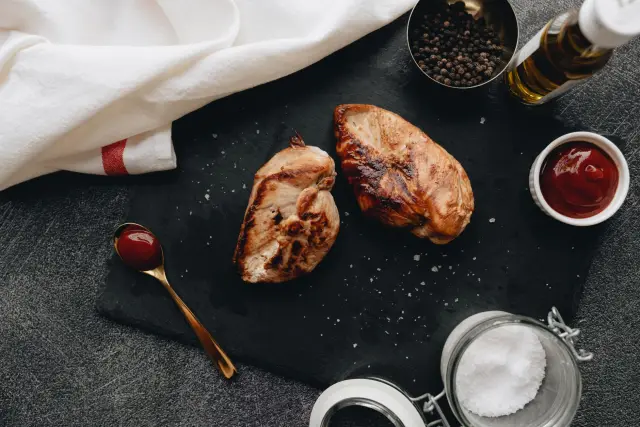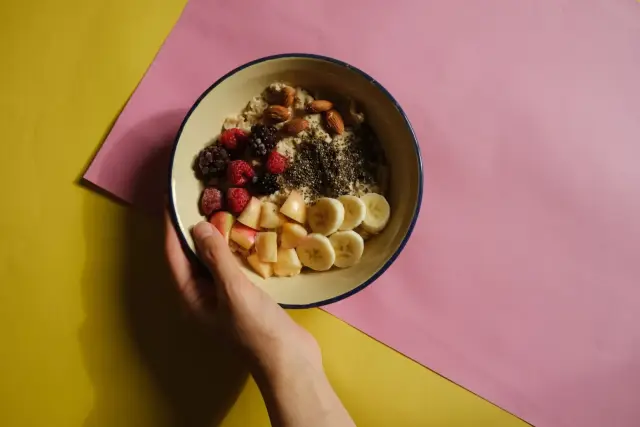

The easiest way to get 100 grams of protein a day is to split it into four meals or snacks of about 25 grams each. In practice, that could be eggs and Greek yogurt at breakfast, chicken at lunch, cottage cheese in the afternoon and salmon at dinner. You do not need shakes or giant portions, but you do need protein at breakfast and lunch.
Below are two full sample days and the grams behind them. All food figures come from USDA FoodData Central and are rounded, so treat them as close estimates.
Split 100 grams of protein into four meals of 25 grams
Trying to find 100 grams at dinner does not work, and your stomach will tell you so. Four rounds of about 25 grams feels completely different. It also fits how muscle responds. In a small study in the American Journal of Clinical Nutrition, muscle protein synthesis after resistance exercise was maximally stimulated at 20 grams of protein in six young men, with 40 grams adding no further increase.
That was one small trial in young men, and older adults may need more per meal. Protein above that level is not wasted either, as we explain in is there a limit to how much protein you can absorb. It is simply a reasonable reason to spread your intake out rather than saving it all for one meal.
How much protein is in common foods
- Chicken breast, cooked: about 32 g per 100 g
- Salmon, cooked: about 22 g per 100 g
- Firm tofu: about 17 g per 100 g
- Cottage cheese, 2 percent: about 10 g per 100 g, or about 24 g per cup
- Plain nonfat Greek yogurt: about 10 g per 100 g, or about 17 g in a 170 g pot
- Lentils, cooked: about 9 g per 100 g, or about 18 g per cup
- Egg, large: about 6 g each
- Peanut butter: about 7 g per two tablespoons
Note the last two. Eggs and peanut butter are useful, but they are not going to carry a meal alone, and peanut butter is mostly fat. The items at the top of the list do the real lifting. For a shopping version, see our high-protein grocery list.
A sample day of 100 grams of protein with meat
- Breakfast, 30 g: two eggs (13 g) and a 170 g pot of Greek yogurt (17 g).
- Lunch, 38 g: a salad or wrap with 120 g of cooked chicken breast.
- Snack, 12 g: half a cup of cottage cheese with fruit.
- Dinner, 22 g: 100 g of salmon with rice and vegetables.
That comes to 102 grams. Nothing on that list is unusual. The biggest change for most people is breakfast, which often goes from toast with about 5 grams of protein to something closer to 30.
A vegetarian sample day of 100 grams of protein
- Breakfast, 30 g: two eggs (13 g) and a 170 g pot of Greek yogurt (17 g).
- Lunch, 18 g: a cup of cooked lentils as a soup or dal.
- Snack, 31 g: a cup of cottage cheese (24 g) with two tablespoons of peanut butter on the side, on apple slices (7 g).
- Dinner, 26 g: a stir fry with 150 g of firm tofu.
That comes to 105 grams. Grains and vegetables on the plate add a little more on top, which we have not counted. A vegan day has to replace the eggs, yogurt and cottage cheese with more tofu, tempeh, beans or a plant protein powder, and mixing sources helps, as covered in what is a complete protein.
Where most people fall short of 100 grams
The arithmetic is unforgiving. If breakfast and lunch bring in 15 grams between them, dinner would need to carry 85, and no ordinary plate does that. A higher-protein breakfast is the most reliable fix, because it takes the pressure off everything after it.
That is what OffRamp's protein log is for. It shows what is left of your floor as the day goes on, so you can find out at 2 PM rather than at bedtime. Quick add keeps your recent foods and common portions close, which helps if your meals repeat from week to week. One of the tips on the home screen says it directly: "Keep an easy protein option on hand for the busy days."
Snacks are the other quiet gap. Swapping one crisp or cookie snack for yogurt, cottage cheese or a boiled egg can add 10 to 20 grams without changing anything else.
How to reach 100 grams with a small appetite
If you are on a GLP-1 medication or your appetite is low for another reason, four solid meals may not be realistic. A few things help:
- Eat the protein first. Start with the part of the plate that counts, in case you fill up early.
- Choose dense foods. Chicken, fish and tofu give you more grams per bite than lentils or beans.
- Go soft or cold. Greek yogurt, cottage cheese and shakes can be easier when solid food does not appeal.
- Use smaller, more frequent rounds. Six rounds of 15 grams gets you to 90, and that is still a very good day.
If you often feel too full or nauseous to reach a reasonable amount, tell your prescriber rather than pushing through.
Is 100 grams of protein a day right for you?
Maybe. It is a tidy round number, not a universal one. OffRamp's formula of 1.6 g per kilogram of goal weight gives you a floor of 100 grams at a goal weight of about 62 kg. Someone with a goal weight of 90 kg would get 145 grams, and someone at 50 kg would get 80. Our guide to how much protein you need per day walks through the range.
If you have kidney disease or your doctor has given you a protein limit, follow that advice over any number here. This article is general education written by a founder, not a clinician.