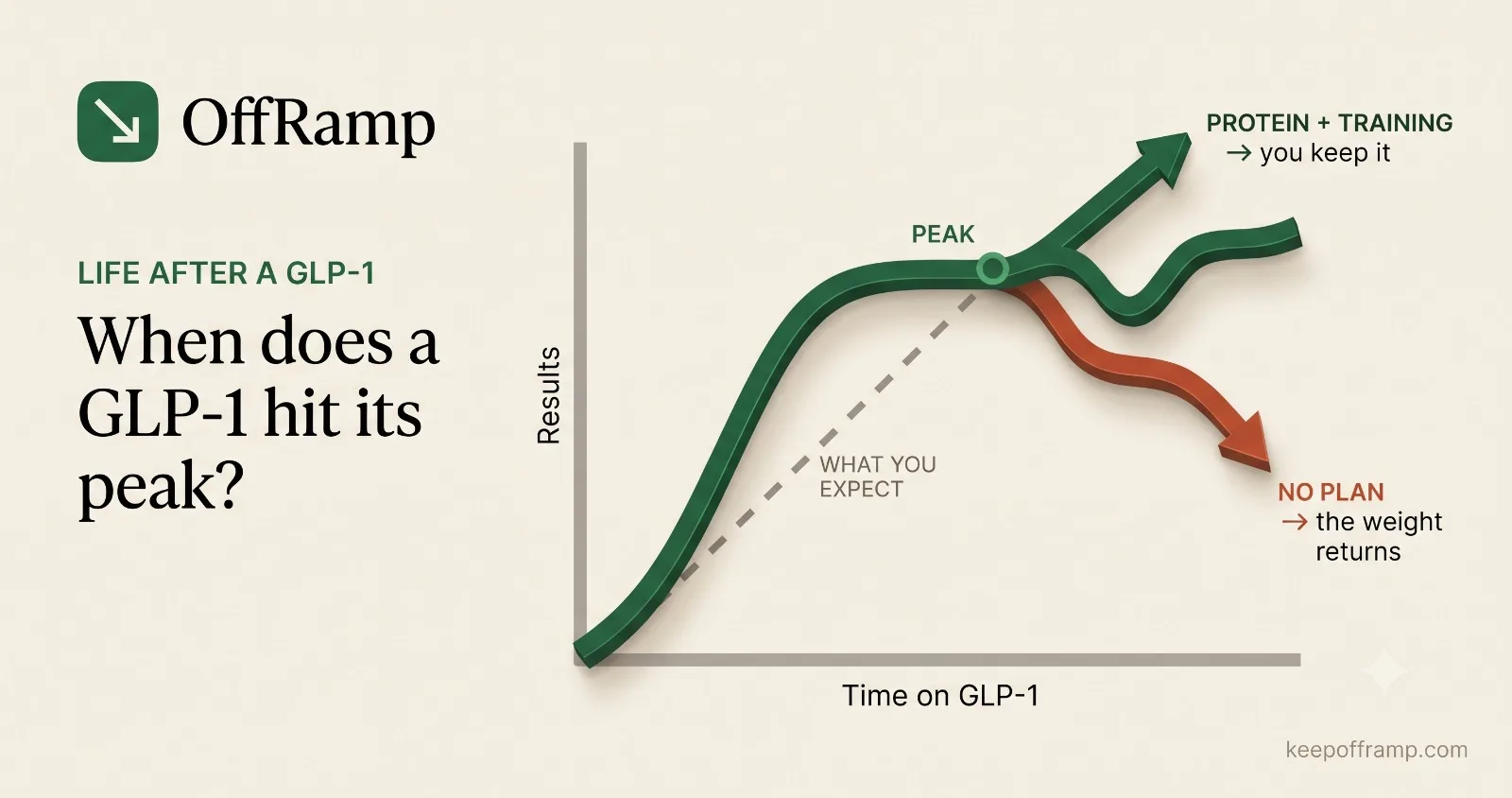
Most people feel a GLP-1 start working within the first few weeks, see the biggest change build over the following months, and then watch the scale level off somewhere around the one-year mark. That leveling off is the plateau, and it is not the medication failing. It is the medication reaching its peak. In the trials, the average weight curve flattens at roughly that point and then holds. So if your loss has slowed to a stop, you are most likely not stuck. You have arrived, and what you do next matters more than anything you did on the way down.
Almost everyone asks the same question in the first month.
When will this really kick in? When do I hit my peak? When will I finally see my dream weight on the scale?
The honest answer to all three is the same, and it starts with you. You step on the scale a little more often than you'd admit. Let's talk about the part almost nobody tells you: that the day the scale stops isn't your peak at all.
The climb, week by week
For most people, something starts happening in the first few weeks. It's usually small, and it's usually quiet. The food noise softens. Portions shrink on their own. The number ticks down a little. It's early, but it's real, and it's often the first time the effort feels like it's landing.
Then comes the long middle. Over the following months the loss builds steadily as the dose climbs. This is the stretch where most of the change happens, and it can feel almost effortless compared to everything you tried before. Your appetite is turned down, so the deficit finally holds instead of getting erased every night.
And then, somewhere around the one-year mark, the scale slows down and levels off.
This is the moment people panic. They assume the drug stopped working, or that they did something wrong.
They didn't. This is just biology doing exactly what it does.
The plateau isn't failure
A plateau is simply the point where the weight stops moving and the scale holds steady, week after week, no matter what you do. It can feel like a wall. It isn't one.
As you lose weight, your body needs less energy to run a smaller body, and it quietly turns some of the hunger back up to defend itself. Eventually the appetite the drug is holding down and the appetite your body is pushing up reach a balance. The scale settles.
That balance point is your weight-loss peak. Not a wall you hit because you failed. A place you arrive because your body found its new floor.
So if you're there, take a breath. You didn't break anything. You reached the top of the climb.

Your real peak isn't the scale. It's what you're left with.
Two people can lose the exact same amount of weight and end up in completely different places.
One of them lost mostly fat. They kept their strength, their shape, their energy. Their body looks and feels like the one they were hoping for.
The other lost a big chunk of muscle along with the fat, because when you're eating less and the pounds are dropping fast, muscle comes off too if nothing is protecting it. They hit the same number on the scale. But they feel weaker, softer, more tired. And their body is now quietly set up to gain the fat back, because muscle is the engine that keeps your metabolism running.
Same scale. Completely different peak.
That's why the real answer to "when does a GLP-1 give you peak results" isn't a date. It's a decision. Your peak is defined by whether you protected your muscle while the medication did its job. And that comes down to two simple things you control:
Eat enough protein. Give your body the raw material to hold on to muscle while the fat comes off. Not a diet, not a calorie count. Just a daily floor you hit.
Do some strength work. A couple of short sessions a week is enough to tell your body: keep this muscle, we still need it.
Do those two things, and the weight you lose is mostly fat. You reach the top of the climb strong instead of depleted. That is the peak worth chasing, and it's the only one that lasts.
The scale peaks on a date. The result peaks on a decision.
Peak isn't a finish line. It's a change of job.
The day the scale stops is the day the job changes.
Up until then, the medication was doing the heavy lifting: dropping the weight for you. Once you peak, the work becomes keeping it, and that's a different skill entirely. The people who stay at their peak aren't the ones who lost the most, the fastest. They're the ones who used the climb to build the muscle and the habits that hold the line when the losing stops.
Reaching your peak doesn't mean you're done. It means you're ready for the part that actually decides how this story ends.
Where to go from here
If you're near your peak, or already there, the road ahead is simple, and it runs through protein. Start with the protein floor guide to see why it matters, and when you're ready for the full picture, how to maintain weight loss after a GLP-1 walks through the whole system.
The scale peaks on its own. The result peaks only if you build for it. That's the whole difference between losing the weight and keeping the life you lost it for.