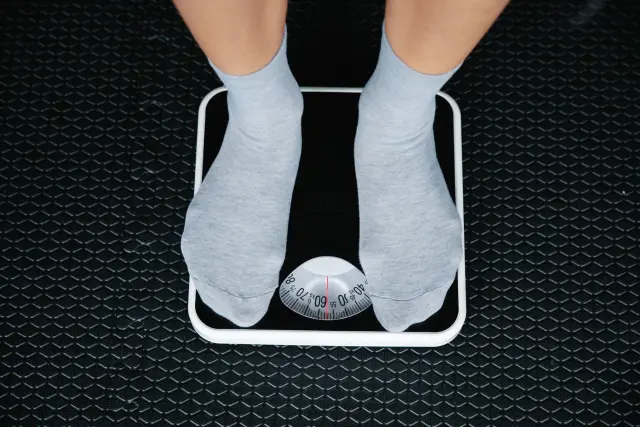
Ask whether you should weigh yourself every day and you will get two confident answers, both citing research, both correct.
That is unusual enough to be worth unpicking, because the resolution turns out to be more useful than either answer on its own.
The short answer
Because for some people it measurably does cause distress, and the research can now say so specifically rather than anecdotally. A randomized trial published in Applied Psychology: Health and Well-Being in 2023 assigned 69 university women aged 18 to 22 to either daily self weighing or a control activity for two weeks, with five daily assessments throughout.
Negative affective lability, meaning the size and frequency of mood swings in the unpleasant direction, was significantly greater in the weighing group. Weight related stress was significantly higher and body satisfaction significantly lower after the behaviour. The authors' own closing line advises caution when recommending self weighing to this age group.
What a randomized trial measured
Two features make this study more informative than the usual survey. It randomized, so the people who weighed and the people who did not were comparable at the start. And it stripped out almost everything else: participants received a graph of their own data with a trend line by email each day, and no other intervention components at all.
No coaching, no eating plan, no goal setting. Just the measurement and the graph. Whatever the effect was, it belonged to the number.
The clever part: a thermometer
The control group did not sit idle. They took their temperature daily, on the same schedule, with the same five daily assessments and the same emailed graph with a trend line.
That design choice is what makes the result interpretable. Both groups measured a bodily variable every day, recorded it, and watched it plotted over time. The only difference was which variable.
And the results split exactly along that line. General stress did not differ between the groups. Weight related stress and body satisfaction did. The number of weight control behaviours did not differ either. So the effect was not caused by daily self monitoring, by the attention to the body, or by the graph. It was specific to weight.
Ten years of follow-up in younger people
A 2015 study in the Journal of Nutrition Education and Behavior followed 1,868 adolescents and young adults through Project EAT, assessing them three times across ten years.
Self weighing correlated positively with weight concern at every time point, in both sexes. In female participants it was inversely related to self esteem at every time point. And over time, increases in self weighing tracked with decreases in body satisfaction and self esteem, and increases in weight concern and depression.
The authors' conclusion is measured and pointed: self weighing may not be an innocuous behaviour for young people, particularly women.
The review that found the opposite
Now the other side, which is equally well evidenced. A 2015 systematic review in Obesity gathered 17 studies with longitudinal data on adults seeking weight loss treatment.
Its finding was that regular self weighing was associated with more weight loss and not with adverse psychological outcomes such as depression or anxiety. That is the evidence base behind every recommendation to weigh yourself regularly, and it is not weak.
Why both results can be true
Look at who was in each study and the contradiction mostly evaporates.
The review covered adults who had actively sought weight loss treatment. These are people who chose the context, arrived with a goal, and typically had support around the number. The trial and the cohort study covered emerging adults and adolescents, a group in the middle of forming a relationship with their own body, most of whom did not choose to be weighed at all.
A tool that helps someone who asked for it can harm someone who did not. That is not a contradiction in the evidence, it is a finding about context that gets flattened whenever the question is posed as whether weighing is good or bad.
Which means the honest version of the advice has a condition attached. If the number helps you act, weigh. If it reliably ruins the next four hours, the research does not oblige you to keep doing it, and there is a real trial supporting that position rather than just permission to feel better.
How OffRamp makes the scale optional
This research is the reason OffRamp does not require a weigh-in and does not have streaks attached to one.
Regain Radar works on a seven day rolling average rather than any individual morning, so no single number ever produces a result on its own. It needs only two weight entries spanning seven days before it will say anything at all, and days with no entry carry the most recent average forward rather than breaking the sequence. Missing a week is not a gap in the data. It is just a week you did not weigh.
That carry forward rule is doing something specific. A tool that resets when you skip a day teaches you to weigh in order to protect the tool, which is the exact incentive the trial above suggests you should avoid. The radar stays quiet unless the seven day average has held at or above your baseline times 1.02 for seven consecutive days, with a stronger alert at times 1.04.
The protein floor is deliberately independent of all of it. It comes from your goal weight at 1.6 grams per kilogram, rounded to the nearest 5 grams, and it does not care whether you have weighed yourself this month. Someone who never steps on a scale still gets a complete, working version of the app, which is not true of most tools in this category.
OffRamp does not provide medical advice or comment on medication. If weighing is bound up with disordered eating, that is a conversation for a clinician or your prescriber rather than an app, and no trend line is a substitute for it.