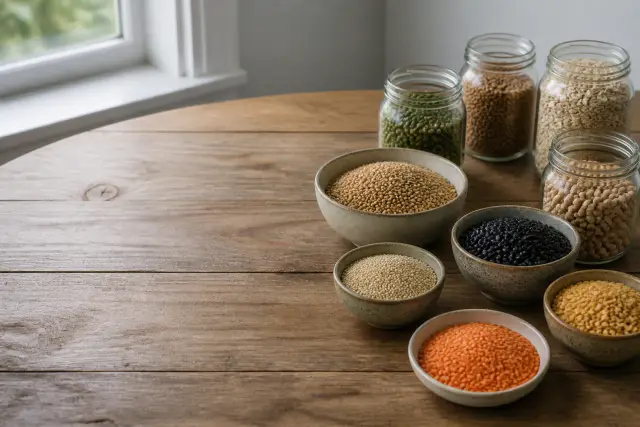

The best complete protein combinations pair a grain with a legume, because each covers what the other lacks. Rice and beans, hummus and pita, peanut butter on wholegrain toast and lentils with rice all work. You do not need to eat both at the same meal. Getting a mix across the day, in enough total grams, does the job.
The bigger question for most people is usually how much protein a plate delivers, and how much of the plate you can realistically finish.
Why a grain plus a legume makes a complete protein
Almost every plant food contains all nine essential amino acids. What differs is the balance. A 2018 analysis in Amino Acids measured plant protein isolates against animal proteins and human muscle, and put numbers on the gap. Lysine averaged 3.6 percent in plant proteins against 7.0 percent in animal proteins. Methionine averaged 1.0 percent against 2.5 percent.
Plants do not all fall short on the same one. As a rule of thumb, grains run low in lysine while legumes run low in methionine. Put them together and the shortfalls cancel out, which is why cuisines around the world landed on rice and dal, corn and beans, or bread and chickpeas long before anyone measured an amino acid.
The same paper concluded that combining plant proteins, or blending plant with animal ones, can produce a profile that closely resembles animal protein. For the scoring theory, see what a complete protein actually is. This post is the practical version.
Eight complete protein combinations, with rough grams
These are approximate figures for ordinary home portions, and brands and cooking methods vary.
- Rice and black beans. One cup of cooked beans plus one cup of cooked rice gives about 20 g.
- Lentils and rice. One cup of cooked lentils plus a cup of cooked rice gives about 22 g.
- Hummus and wholewheat pita. A quarter cup of hummus and one pita gives about 10 g.
- Peanut butter on wholegrain toast. Two tablespoons on two slices gives about 15 g.
- Chickpea curry and flatbread. One cup of chickpeas plus a piece of flatbread gives about 20 g.
- Pasta with white beans. A cup of cooked pasta with half a cup of beans gives about 15 g.
- Bean soup and wholegrain bread. A large bowl with one slice gives about 15 g.
- Tofu and rice. Tofu is complete on its own, but 150 g of firm tofu with a cup of rice gives around 25 g and makes the plate a meal.
Vegetarians who eat eggs and dairy have an easy shortcut. A small amount of either alongside a grain, such as oats made with milk or a slice of cheese on bread, tops up lysine and methionine without any further thought.
Do complementary proteins need to be at the same meal?
No. Strict same-plate pairing was popular advice decades ago and it has since been abandoned, as our complete protein explainer covers. Your body keeps a working supply of amino acids, so beans at lunch and rice at dinner are fine. What matters is variety and total protein across the day.
That takes real pressure off. Nobody needs a chart taped to the fridge. If your week includes a few legumes, a few grains and maybe some soy, the amino acids take care of themselves.
Does plant protein build muscle as well as animal protein?
Close to it, with a caveat. A 2021 meta-analysis in Nutrients pooled randomized trials and found protein source did not affect changes in absolute lean mass or muscle strength. There was a favoring effect of animal protein on percent lean mass, and younger adults under 50 gained somewhat more absolute lean mass on animal protein, about 0.41 kg.
Total protein in these trials was generally above the recommended allowance, and that is the caveat. Plant protein performs well when you eat plenty of it. Gorissen's numbers explain why: plant isolates such as oat, lupin and wheat were 21 to 22 percent essential amino acids, against 43 percent for whey and 39 percent for milk. Grams count for more on a plant-based plate, and you may need a bit more to get the same effect.
Making plant protein work with a small appetite
Here is the problem nobody mentions in the usual lists. Rice and beans is filling, which is great on most days and a real obstacle if your appetite is reduced. In a crossover trial of semaglutide, people ate 24 percent less at free-eating meals. A large bowl that delivers 20 g may simply not get finished.
So on low-appetite days, change the ratio:
- Lead with soy. Tofu, tempeh and edamame bring far more protein per bite than beans.
- Keep the grain small. A few spoonfuls of rice, with most of the bowl being lentils or tofu.
- Drink some of it. A pea and rice protein blend is a complete pairing in a glass.
- Add seeds and vegetables. Higher protein vegetables can add a few useful grams without much bulk.
This is why OffRamp counts grams and never scores protein quality. When we built the protein floor, 1.6 g per kilogram of goal weight, we left out amino acid grades on purpose: one honest number gets used, while a chart of nine does not. Rice and beans and a chicken breast go into the same daily total. If a plant-based diet is new to you, or you have kidney disease or another condition, check with your clinician or dietitian. Our general list of high protein foods for a GLP-1 appetite has more options.