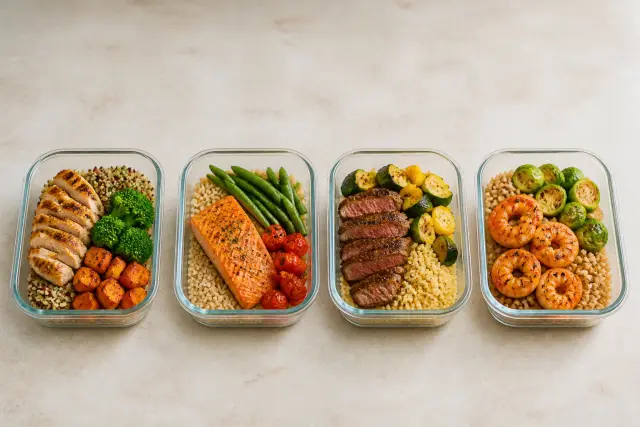
Meal prep is usually presented as a test of character. Either you are the sort of person with eleven matching containers, or you are not, and the containers do the arguing.
The research points somewhere less flattering and more useful. It is not really about discipline. It is about when the decision gets made.
The short answer
Yes, with a caveat about what the evidence can prove. A 2017 study in the International Journal of Behavioral Nutrition and Physical Activity assessed meal planning in 40,554 adults from the French NutriNet-Sante cohort. About 57% said they planned meals at least occasionally. Those who did were more likely to sit in the top quartile for overall food variety, with an odds ratio of 1.25, and more likely to score well on adherence to national dietary guidelines. Among women, meal planning was associated with 21% lower odds of obesity. Among men the association held for obesity as well.
That study is cross-sectional. It cannot tell you that planning caused any of it, and the authors say so plainly in their own conclusion. What it can tell you is that planners and non-planners are eating measurably different food.
What 40,554 adults actually showed
The size is what makes it worth reading. Most nutrition behaviour studies run a few hundred people through a questionnaire. This one had over forty thousand participants with repeated 24 hour dietary records rather than a single recall, which is a much harder thing to fake in either direction.
The variety finding is the one people skip over. Planners were not eating a narrower, stricter, more joyless diet. They were eating a wider range of foods. That is the opposite of what the container photographs imply, and it is the finding that most changes how you should think about the habit.
The cooking frequency data underneath it
Meal planning and home cooking are not the same thing, but they travel together. A 2015 analysis in Public Health Nutrition looked at 9,569 US adults in the 2007 to 2010 NHANES survey and sorted them by how often someone in the household cooked dinner.
Households that cooked dinner six or seven nights a week took in less total energy, less fat, and notably less sugar than households cooking once a week or not at all. The sugar gap was the largest of the three, at 119 grams a day against 135. Here is the part that matters for maintenance: the pattern held whether or not the person was actively trying to lose weight. Cooking at home was not a diet behaviour. It was a default.
Why planning beats willpower
Both studies point at the same mechanism, and it is not self control. It is that a planned meal is decided by a version of you who is not hungry, not tired, and not standing in a kitchen at seven in the evening with nothing thawed.
Hunger does not just make you want more food. It narrows the range of food you will consider. Ask someone who has not eaten since noon what they want and the answer converges on fast, salty and dense with remarkable reliability. Prep does not defeat that impulse. It just means the impulse arrives after the decision has already been made.
This is why the variety result makes sense. Choosing a week of meals on a Saturday afternoon lets you pick things that sounded good in the abstract. Choosing dinner while starving picks whatever is fastest.
Where meal prep reliably falls apart
Three failure modes show up over and over, and none of them are about motivation.
The first is repetition. Cooked food keeps three to four days in a fridge, which means a full Sunday prep is asking you to eat the same thing four times in a row. By Wednesday most people are negotiating with themselves.
The second is scope. People start by prepping every meal, seven days, three a day, and treat anything less as failure. That is roughly twenty one commitments made in one afternoon by someone feeling optimistic.
The third is that prep quietly becomes a way of avoiding food rather than organising it. If the containers are getting smaller each week, that is not better planning. That is a restriction habit wearing a productivity costume, and it is the version most likely to end in the rebound the rest of this site is about.
Prep is a delivery system, not a target
Prepping tells you what is in the fridge. It does not tell you whether the week added up to enough of the thing that protects muscle while your weight is stable or falling.
That is a separate question, and it is the one OffRamp is built around. The app sets a daily protein floor at 1.6 grams per kilogram of your goal weight, rounded to the nearest 5 grams. It is a floor, not a ceiling and not a calorie target, because the failure people actually hit in maintenance is undereating protein while eating plenty of everything else.
A prepped week makes that floor much easier to clear, since the same four or five components repeat and the logging becomes near automatic. That is the honest case for meal prep: it does not add willpower, it removes decisions.
How OffRamp treats prepped food
There is no meal prep feature in OffRamp, and that was deliberate. Building a prep planner would have meant recommending specific weekly menus, which slides quickly toward prescribing intake, and this app does not do that.
What it does instead is notice repetition. The insights engine surfaces your most logged protein source over a window, which for anyone prepping is usually the exact thing they batch cooked on Sunday. Seeing it named back to you is a small thing, and it is the point at which most people realise their week has three foods in it rather than a dozen.
The weight side runs separately. Regain Radar compares a seven day rolling average against your baseline and only says anything once the average has held at or above baseline times 1.02 for seven consecutive days. A Sunday cook and a Wednesday takeaway both disappear into that average, which is the entire reason it is measured that way.
None of this is medical guidance, and OffRamp never advises on medication. If you are on or coming off a prescribed treatment, that conversation belongs with your prescriber. What the app can do is make the ordinary week legible enough that you notice a drift before it becomes a regain.