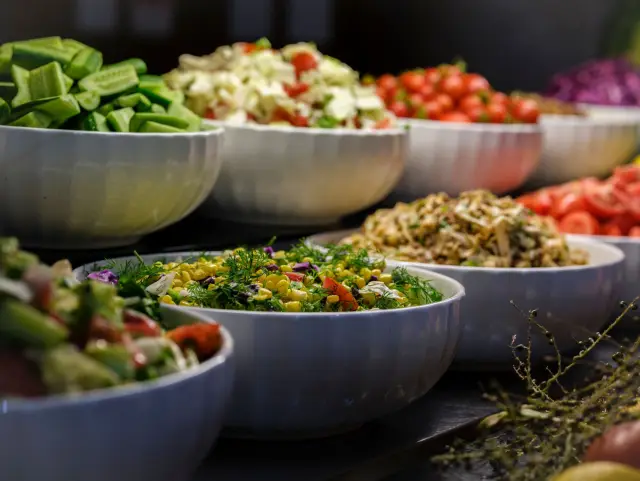
You are full. You still want dessert. That is not a failure of willpower, it is a well documented feature of how appetite actually works, called sensory-specific satiety, and it was demonstrated in a lab decades before anyone had a name for the "dessert stomach" myth.
Here is the mechanism, and why it is not the same thing as a second stomach.
The short answer
A 1981 study in Physiology and Behavior by Barbara Rolls, Edmund Rolls, Edith Rowe, and Marion Sweeney gave people a food to eat, then measured how much they still wanted that food versus foods they had not eaten. The pattern was consistent: pleasantness ratings for the eaten food dropped, while ratings for untried foods barely moved.
That decline is specific to the food itself, its flavour, texture, and appearance, not to your stomach's overall capacity. Introduce a new flavour, especially something sweet after something savoury, and the appeal resets, because it is a different food.
Why it is not a second stomach
Your stomach does not grow a separate compartment for cake. What changes is entirely in how your brain rates the food in front of you, not how much physical space is left. The original studies measured this with pleasantness ratings on a scale, taken before and after eating, and the ratings track the specific food eaten far more closely than they track how full someone reports feeling.
That distinction matters because it reframes what is happening at the end of a big dinner. You are not tricking your body into eating past capacity. You are experiencing an accurate signal about a different food, layered on top of an accurate signal about the food you just finished.
Why this mechanism exists at all
Sensory-specific satiety has an obvious evolutionary logic. A signal that makes a single food less appealing the more of it you eat, while leaving other foods fully appealing, pushes toward dietary variety instead of eating one available food source to the exclusion of everything else. Variety, historically, meant a broader range of nutrients.
The same mechanism that once protected against nutrient gaps now works against you at a modern buffet or a holiday table stacked with different dishes. Each new course resets the appeal clock, and the number of separately appealing foods in front of you, not your actual hunger, ends up driving how much you eat.
What actually reduces the pull
Because the effect is tied to variety, the practical lever is also variety, in the other direction. A meal built from fewer, more similar flavours produces less of the pull toward "one more different thing" than a meal with many distinct dishes and textures. Ending a meal with more of what you already ate, rather than something new, taps the same logic: the food you are reaching for has already lost some of its pull.
None of that requires forbidding dessert or treating the craving as a discipline failure. It is closer to understanding which meal shapes make the pull stronger or weaker, and choosing on purpose rather than being surprised by it every time. A tasting menu with eight distinct courses is, by this mechanism, almost designed to make you eat more than the same total food served as two large plates, and knowing that is more useful than blaming the meal on a lack of self control afterward.
Why this is the actual mechanism behind buffet overeating
Buffets are the clearest real world demonstration of the effect, and it is worth being specific about why. It is not that a buffet offers more total food than a plated meal, plenty of restaurants do that too. It is that a buffet offers more distinct foods in front of you at once, each one still carrying its full, unspent appeal because you have not eaten any of it yet.
Every additional dish on the table is, in effect, a fresh reset of the sensory-specific satiety clock. That is also why the common advice to "take a lap before you fill your plate" has a real mechanism behind it: it does not reduce the pull of variety, but it lets you choose which specific foods you want that reset to apply to, rather than defaulting to whatever is closest.
How OffRamp treats a protein floor as independent of this
OffRamp never asks whether you are full, and it never tracks calories. The one number it holds you to is a protein floor, calculated as 1.6 grams per kilogram of your goal weight, rounded to the nearest 5 grams. A dessert built around real protein, Greek yoghurt, cottage cheese, a protein based mousse, counts toward that floor exactly the same as anything eaten earlier in the meal.
That design choice exists because sensory-specific satiety is not a problem to be engineered around. It is a normal, well studied part of appetite, present in essentially everyone regardless of weight or goals. An app that scolded you for wanting something sweet after a full meal would be arguing with basic physiology, not helping you maintain anything.
OffRamp does not provide medical advice, diagnosis, or dosing guidance, and this pattern is not one it treats as something to fix. If wanting dessert regularly turns into something that feels compulsive rather than pleasurable, that shift is worth mentioning to a therapist or your prescriber, since it is a different question than the one this research answers.