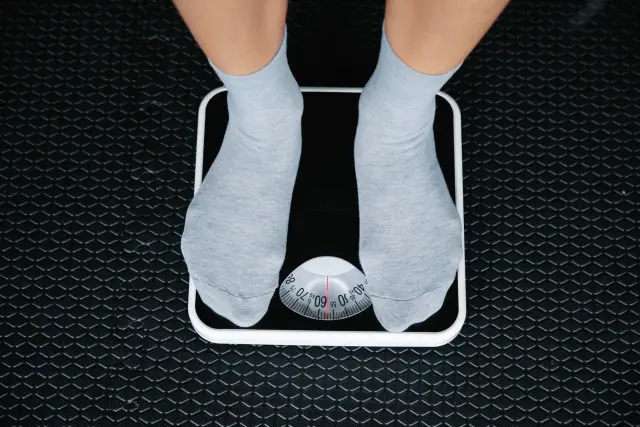

Weigh yourself first thing in the morning, after using the toilet, before you eat or drink anything, wearing roughly the same amount of clothing. That is the whole protocol. It works not because morning is a special metabolic window but because it is the most repeatable point in your day: the least food in your gut, the least fluid in your bladder, the fewest variables.
What most advice leaves out is the second half. Comparing Thursday with Sunday will mislead you even if both readings were taken perfectly, because body weight has a weekly rhythm of its own.
The best time, specifically
Four conditions, in order of how much they matter:
- Morning, before anything passes your lips. A litre of water weighs a kilogram. Drink it, step on, and the scale faithfully reports a kilogram of water.
- After the toilet. Overnight your bladder fills reliably, so emptying it first removes a predictable few hundred grams.
- Same clothing, or close to it. Jeans and a jumper versus underwear is comfortably half a kilo.
- Same scale, same hard floor. Carpet changes the reading on most scales. Pick one spot and leave the scale there.
Evening weights are not wrong, they are just noisier, and they are usually higher by a kilogram or more because a day of food and drink is still being processed. If evening is the only time you will reliably do it, weigh in the evening, every time, and judge the trend rather than the number.
Why the same time beats the right time
A single weight is nearly meaningless on its own. What carries information is the difference between two weights, and a difference is only real if everything except your body stayed the same. Change the time of day and you have measured your digestion. Keep it fixed and you have measured yourself.
This is also why one morning spike is not news. Daily variation of one to two kilograms is ordinary, driven by sodium, carbohydrate stores, hormones and bowel timing. We put real figures on that in how much your weight fluctuates in a day and in what water weight actually is.
The day of the week matters too
This is the part that surprises people. A study in Obesity Facts tracked 80 adults with BMIs from 20.0 to 33.5, aged 25 to 62, across 4,657 daily weigh-ins over periods of 15 to 330 days. A clear group-level weekly pattern appeared: weight was highest early in the week, on Sunday and Monday, and fell through the week. Increases began on Saturday. Decreases began on Tuesday.
The authors drew a conclusion worth quoting in spirit: weekend-to-weekday variation should be considered normal rather than a sign of weight gain. More interesting still, the people who swung the most and compensated the most through the week were the ones most likely to lose or maintain over time. The people who gained slowly were the ones who compensated least.
So Monday is the worst day to judge yourself and the best day to misread yourself. If you weigh once a week, pick a weekday and keep it. If you weigh daily, compare like with like: this Monday against last Monday, not against Friday. Our piece on whether you gain weight on weekends has the per-day figures.
Does weighing daily actually help
A systematic review and meta-analysis in the International Journal of Behavioral Nutrition and Physical Activity looked at exactly this. Three findings are worth holding onto.
First, self-weighing on its own did not show an effect: the one trial that tested it alone found -0.5 kg with a confidence interval from -1.3 to 0.3, which crosses zero. Second, adding self-weighing to a behavioural programme produced a significant -1.7 kg, and programmes that included self-weighing beat minimal control by -3.4 kg. Third, and most usefully for this question, there was no significant difference between instructing daily and weekly weighing.
Read together, the scale is not the intervention. It is an instrument that makes an intervention steerable. The review also found that trials including accountability produced significantly greater weight loss, which is to say the number matters when something happens as a result of it. How often you should weigh yourself covers the frequency question in full, including when stepping on daily is the wrong idea for someone.
Four ways people get the reading wrong
Most bad weight data comes from four habits. Weighing after a workout, when you are a litre of sweat lighter and will drink it straight back. Weighing after a travel day, when sodium and sitting still have you holding fluid. Weighing on a new scale and comparing with the old one, which can differ by a kilogram and tells you nothing about your body. And weighing twice, keeping the lower number, then comparing it with tomorrow's honest one.
That last one is common enough that OffRamp handles it in code rather than asking people not to do it.
What to do with the number once you have it
Judge the average, never the morning. OffRamp computes a 7 day rolling average and compares it with your own baseline, and it is deliberately slow to call anything. Drift is only reported when that average sits at or above 1.02 times your baseline on seven consecutive days, with a louder alert at 1.04 held the same way. With an 80 kg baseline, the drift line is 81.6 kg, sustained a full week. A heavy weekend cannot trigger it. A real trend eventually will.
Two details in the cleaning step exist because of how people actually weigh themselves. If you step on more than once in a day, OffRamp averages those readings instead of taking the first or the best, so the two-attempts habit cannot bias the trend. And a single day that sits more than 10 percent away from its neighbouring days is dropped as a typo, because 180 kg typed for 80 kg, or pounds entered where kilograms were expected, would otherwise corrupt the average for a week. The engine also refuses to call anything at all until it has at least two entries spanning seven days, and tells you how many days are left instead.
That is the real answer to the timing question. Pick the morning, pick a day, keep both, and then hand the judging to something that looks at seven days rather than at today.