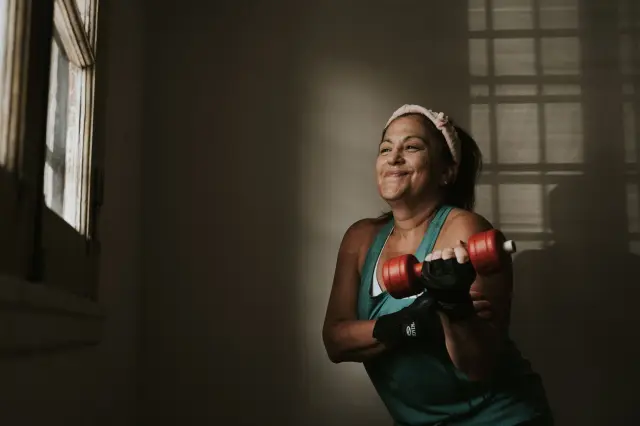

Resistance bands build muscle and strength about as well as dumbbells and machines. A systematic review and meta-analysis of 8 studies, published in SAGE Open Medicine, compared elastic devices with conventional ones and found no superiority either way: lower limb strength came out at a standardised mean difference of -0.11 with a confidence interval of -0.40 to 0.19, and upper limb strength at 0.09 with an interval of -0.18 to 0.35. Neither result was close to significant.
In plain terms: across different populations and protocols, the tubes and the dumbbells produced the same strength gains. Muscle responds to tension and effort, and it has no way of knowing whether that tension came from rubber or iron.
What the meta-analysis found
The review searched PubMed, EMBASE, PEDro and the Cochrane register, and pooled the eight trials that compared elastic resistance, meaning tubes and Thera-Bands, against conventional resistance, meaning weight machines and dumbbells, with muscular strength as the outcome. The authors' own conclusion was that elastic resistance training is able to promote similar strength gains to conventional resistance training in different population profiles and using diverse protocols.
Two honest caveats. Eight studies is a small evidence base, and the outcome measured was strength rather than muscle size, which were not well enough covered to pool. So the strong claim is about getting stronger. The claim about building visible size rests on the general principle that the stimulus is tension and effort, which is well supported but not what this particular analysis measured.
Why bands work at all
A muscle cannot distinguish sources of resistance. It registers how hard it had to contract and for how long. A band that is genuinely difficult for the last two repetitions of a set is providing the same signal as a dumbbell that is genuinely difficult for the last two repetitions.
Bands differ in one real way: resistance rises as the band stretches. A band chest press is easiest at the start and hardest at full extension, which is the reverse of a dumbbell press, where the bottom is hardest. That changes which part of the movement is loaded most, not whether the movement counts.
Where bands genuinely fall short
Three limitations are worth naming rather than talking around.
Heavy lower body work is the main one. Legs are strong, and producing enough band tension to challenge a squat means stacking bands or standing on them awkwardly. Upper body pulling, by contrast, is where bands shine, because the loads involved are smaller and an anchored band mimics a row very closely.
Measurement is the second. There is no number stamped on the resistance, so you cannot tell whether this week was harder than last week except by how it felt. That makes bands worse for anyone who stays motivated by watching a figure rise.
Durability is the third and most mundane. Bands wear, and a worn band is a quietly easier band. Replace them when they go tacky or cloudy.
How to progress without a number on a plate
Progression is the entire game, with any equipment. With bands you have four levers. Move to a thicker band. Shorten the band, by wrapping it, so the movement starts under tension instead of slack. Step further from the anchor point. Or slow the lowering phase, taking three or four seconds to return.
That last one is the most underused and costs nothing. Time under tension was one of the variables most strongly associated with strength gains in the dose-response data, and a slow return doubles it without any change of kit. How many sets a week to build muscle covers the volume side of progression.
How many sessions a week
A dose-response meta-analysis in Sports Medicine pooled resistance training trials in healthy older adults and found training improved strength substantially, with a mean standardised effect of 1.57 across 25 studies. When the authors isolated individual training variables, the most effective values were two sessions a week, two to three sets per exercise, and seven to nine repetitions per set.
Two sessions a week being the standout frequency is a useful finding, because two is the number most people can actually hold onto through a working week. OffRamp's resistance band plan is built on exactly that: two sessions, 20 minutes each, four exercises per session. The upper session runs band chest press, band row, band overhead press and band pull-apart. The lower session runs band squat, band deadlift, lateral band walk and band glute kickback. Every exercise carries its cue and the mistake people usually make, because a band row done with a rounded back is a wasted band row.
The default weekly target in the app is two sessions, deliberately, so a week closes when the second one is logged rather than accumulating guilt about a third. How often to strength train goes into the weight-loss side of frequency.
Why this matters more in maintenance
Here is why OffRamp ships a band plan at all rather than assuming a gym. The people this app is built for have usually just come through rapid weight loss, often on a GLP-1, and a meaningful share of what they lost was lean tissue. The job in maintenance is not building a new physique. It is holding onto the muscle that is left, and holding it for years.
For that job, the equipment that gets used beats the equipment that is theoretically optimal. A band costs the price of a coffee, lives in a drawer, works in a hotel room, and according to eight pooled trials builds strength comparably to a machine you would have to leave the house for. We go through what lifting actually protects during a deficit in does strength training preserve muscle during weight loss, and the longer-term version in preventing sarcopenia.
Pair it with protein. Training supplies the signal to keep muscle and protein supplies the material, and neither does the job alone.